Breastfeeding Positions: 6 Holds, Step by Step, and Which One to Choose
By Breastfeeding Mom Editorial TeamUpdated 7 min read

The way you hold your baby changes how deeply they latch, how fast the milk flows and how your back, arms and nipples feel after a feed. Most parents end up using two or three favorite breastfeeding positions, swapping between them for different times of day and different problems.
This guide walks through six holds step by step, explains who each suits, and helps you pick one for common situations. If you’re brand new to breastfeeding, start with our guide on how to breastfeed, which covers the latch itself.
Before you start: what every position needs
Whatever hold you choose, the NHS and HealthyChildren.org (AAP) describe the same basics:
- Get comfortable first, with your back and arms supported and your shoulders relaxed.
- Head and body in a straight line. It’s hard for a baby to swallow with their head twisted.
- Baby close, facing the breast, tummy toward you.
- Nose level with your nipple, so your baby tips their head back and opens wide.
- Bring your baby to the breast, not the breast to the baby. Support the neck and shoulders rather than pushing the back of the head.
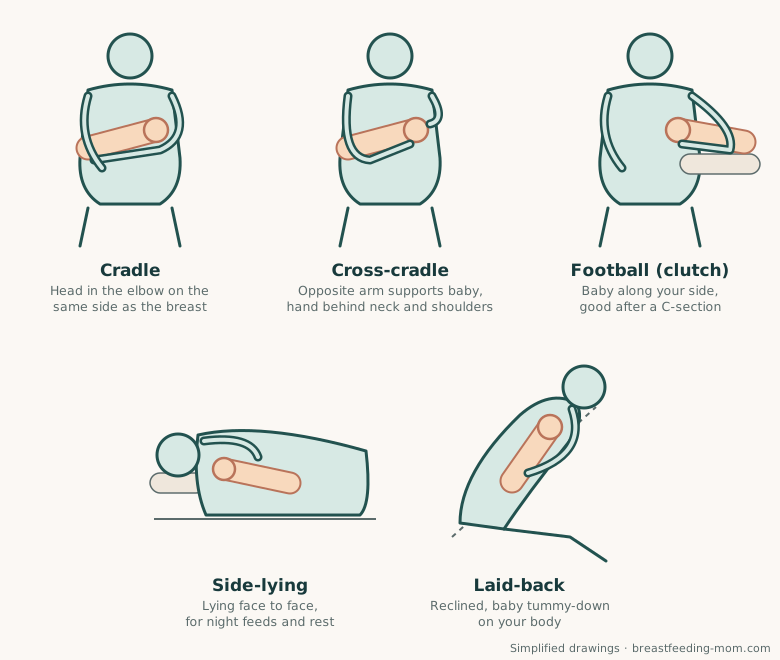
1. Cradle hold
The classic position, often easier once your baby latches well.
How to do it (HealthyChildren.org):
- Sit upright with your back supported. Rest your baby’s head in the crook of the elbow on the same side as the breast you’re using.
- Support their back with your forearm and their bottom or thigh with your hand.
- Turn your baby’s whole body to face you, so their head lines up with their body.
- Use your free hand to support or shape your breast if needed.
Good for: babies who already latch well and older babies. Cleveland Clinic lists it among upright holds that can help gassy babies.
Watch out for: La Leche League notes that the cradle can be hard to master early on. With a newborn, it’s easy for the head to slip back from the breast.
2. Cross-cradle hold
The same idea as the cradle, but you switch arms for more control.
How to do it:
- Hold your baby with the arm opposite the breast you’re feeding from. Your forearm supports their back; your hand supports the base of the neck and shoulders.
- Your baby’s bottom rests in the crook of your arm or on a pillow.
- Your free hand shapes the breast. As your baby opens wide, bring them in chin first.
Good for: newborns, small babies and babies who struggle to latch deeply. The Australian Breastfeeding Association suggests switching to a cradle hold for comfort once the feed is going.
Watch out for: gripping the back of the head, which pushes the chin down. La Leche League also notes that some research links the cross-cradle hold to more nipple pain, so switch if it hurts.
3. Football (clutch or underarm) hold
Your baby lies along your side, tucked under your arm.
How to do it:
- Put a pillow beside you. Lay your baby on it, on the side you’re feeding from, with their legs toward your back.
- Support their upper back with your forearm and their shoulders, neck and head with your hand.
- Keep their head level with your breast. If you’re in a chair, their bottom can rest against the chair back with their legs angled up.
Good for: recovery after a C-section, because your baby’s weight is off the incision; larger breasts or flat nipples; twins (one on each side); premature babies (HealthyChildren.org); and seeing the latch clearly (La Leche League). Our guides to breastfeeding after a C-section and breastfeeding twins cover these situations, including the double football hold.
4. Side-lying
You and your baby lie on your sides, facing each other.
How to do it:
- Lie on your side with a pillow under your head and one behind your back. A pillow between your knees helps.
- Lay your baby on their side, tummy to tummy, with their nose level with your nipple.
- Bring them in chin first from below the breast. Use your free hand to support the breast if needed.
- To switch sides, HealthyChildren.org suggests hugging your baby to your chest and rolling over, or raising your baby on a pillow to reach the upper breast.
Good for: night feeds and naps, resting after a C-section or a sore perineum, and a fast let-down (Cleveland Clinic).
Watch out for: falling asleep. Cleveland Clinic stresses staying awake and alert. Our full guide to side-lying breastfeeding explains the AAP’s safe sleep advice for feeding in bed.
5. Laid-back (biological nurturing)
You recline and your baby lies on top of you, tummy down.
How to do it:
- Lean back in a semi-reclined position, supported but not flat, on a bed, couch or chair. La Leche League suggests raising your feet.
- Place your baby tummy to tummy on your body, head near your breast. Gravity holds them close.
- Let your baby bob and root toward the breast. Once they’re latched, tuck pillows under your arms or elbows.
Good for: the early days, a stressed baby or a hard-to-get latch (La Leche League); a strong let-down or oversupply (HealthyChildren.org); and spit-up and C-section recovery (Cleveland Clinic).
What the evidence says: a 2021 meta-analysis of 12 studies (1,936 mother-baby pairs) found less nipple pain and nipple damage and more correct latches with laid-back feeding than with traditional positions, though it found no difference in comfort and the included studies had limitations. A 2023 randomized trial of 168 first-time mothers found no difference in their overall breastfeeding experience between laid-back and cradle holds. In short: laid-back is worth trying, especially if your nipples are sore, but it isn’t magic.
6. Koala (upright or straddle) hold
Your baby sits upright, facing you, straddling your thigh or sitting on your lap.
How to do it:
- Sit upright. Sit your baby astride your thigh, facing your breast, with their spine and head upright.
- Support their back and neck with one hand and shape the breast with the other if needed.
- Bring your baby to the breast with their nose level with your nipple, as in any other hold.
Good for: a fast milk flow or oversupply (La Leche League GB suggests a “koala hold”); babies who don’t like lying on their side (Australian Breastfeeding Association); older babies with good head control, feeding out and about, and parents who use a wheelchair or have limited mobility (Cleveland Clinic). Younger babies need plenty of support at the neck and shoulders.
Which position should you try?
| Situation | Positions to try |
|---|---|
| Newborn who struggles to latch | Cross-cradle, laid-back, football |
| Sore or damaged nipples | Laid-back; vary positions so pressure falls on different spots |
| After a C-section | Football, side-lying, laid-back |
| Twins | Double football |
| Fast let-down or oversupply | Laid-back, koala, side-lying |
| Larger breasts | Football; support the breast or tuck a rolled towel under it |
| Gassy or spitty baby | Laid-back, cradle |
| Night feeds or exhaustion | Side-lying (with a safe sleep plan) |
| Preventing clogged ducts | Vary positions; HealthyChildren.org notes each one drains different areas of the breast |
If the milk flow seems to overwhelm your baby, our guide to block feeding explains how fast let-down and oversupply are managed. A breastfeeding pillow can make several of these holds easier, though it’s never a safe place for your baby to sleep.
When to get help
Changing position fixes many problems, but not all. Talk to a lactation consultant (IBCLC), your midwife or your baby’s doctor if:
- Feeds hurt beyond the first few sucks in every position, or your nipples look pinched, creased or cracked after feeds (our guide to sore nipples explains the causes)
- Your baby clicks, slips off the breast or can’t stay latched, which can be a sign of tongue tie
- Your baby has fewer wet and dirty diapers than expected, or isn’t gaining weight well
- You’ve had a C-section and can’t find a position that doesn’t press on your incision
An IBCLC can watch a feed and adjust your hold in minutes, which is often faster than trial and error. Our breastfeeding support page lists where to find one, and our breastfeeding basics hub has more guides for the early weeks.
Frequently asked questions
What is the best breastfeeding position for a newborn?
Many parents start with cross-cradle, football or laid-back. Cross-cradle gives you more control of your baby's head, and La Leche League suggests laid-back for the early days and a hard-to-get latch. Use whichever gives the deepest, most comfortable latch.
Should I switch breastfeeding positions?
It can help. HealthyChildren.org (AAP) says that using different positions may help prevent sore nipples and clogged ducts, since each position drains different areas of the breast.
Do I need a nursing pillow for these positions?
No, but pillows make most holds more comfortable by bringing your baby up to breast height and supporting your arms. Regular pillows or a rolled towel work, and a pillow should never be used for your baby to sleep on.
Can I breastfeed my baby in a sling or carrier?
The NHS says it is not safe to breastfeed your baby while they are in a sling or carrier. Take your baby out of the sling or carrier to feed.
Sources
- HealthyChildren.org (AAP): Breastfeeding Positionshttps://www.healthychildren.org/English/ages-stages/baby/breastfeeding/Pages/Positioning-Your-Baby-for-Breastfeeding.aspx
- Cleveland Clinic: Breastfeeding Positionshttps://health.clevelandclinic.org/breastfeeding-positions/
- La Leche League International: Breastfeeding Positions, Latch, and Positioninghttps://llli.org/breastfeeding-info/positioning/
- Australian Breastfeeding Association: Positioninghttps://www.breastfeeding.asn.au/resources/positioning
- La Leche League GB: Oversupply: too much milkhttps://laleche.org.uk/too-much-milk-and-oversupply/
- NHS: Breastfeeding positioning and attachmenthttps://www.nhs.uk/baby/breastfeeding-and-bottle-feeding/breastfeeding/positioning-and-attachment/
- Wang Z et al. The effectiveness of the laid-back position on lactation-related nipple problems and comfort: a meta-analysis (BMC Pregnancy Childbirth, 2021)https://europepmc.org/article/MED/33761882
- Bashiri A et al. Comparing the effects of breastfeeding in the laid-back and cradle position: a randomized clinical trial (Trials, 2023)https://europepmc.org/article/MED/36782308
This guide is general information, not medical advice. For your own situation, talk to your doctor, midwife, pharmacist or an IBCLC lactation consultant. Read our medical disclaimer and find breastfeeding support near you.
Related articles

How to Breastfeed: Step-by-Step Latch and the Best Positions
A step-by-step guide to getting a deep, comfortable latch, five breastfeeding positions to try, and the beginner mistakes that are easy to fix.

Side-Lying Breastfeeding: How to Do It Safely
How to breastfeed lying on your side, step by step, who it helps most, how to switch sides, and what the AAP says about feeding in bed and safe sleep.

Breastfeeding Twins: Positions, Milk Supply and a Plan That Works
How to breastfeed twins: building enough milk, feeding together or one at a time, the best tandem positions, pumping for preterm twins and getting help.

Breastfeeding After a C-Section: First Feeds, Positions and Pain Relief
How to breastfeed after a C-section: skin-to-skin in the OR, comfortable positions that protect your incision, pain relief, and help if milk is slow.