Flange Inserts: Who Needs Them and How to Choose the Right Size
By Breastfeeding Mom Editorial TeamUpdated 5 min read

If pumping hurts, or your nipple seems lost in the flange tunnel, the size of the flange may be the problem. Many pumps come with only one or two sizes, and they don’t fit everyone. Flange inserts are a simple way to make a flange you already own smaller.
This guide explains what inserts are, who they help, how to measure, and how to tell whether the fit is right. We don’t recommend brands; we explain what to look for. For the wider picture, see our pumping guides.
What is a flange insert?
The flange (also called a breast shield) is the funnel-shaped part of your pump that rests on your breast. Your nipple moves in and out of its narrow tube, called the tunnel. Cleveland Clinic explains that flange size means the width of that tunnel, measured in millimeters, and that sizes range from 13 mm to more than 30 mm. Many pumps come with a standard medium size of about 24 mm.
An insert is a sleeve, usually silicone or plastic, that sits inside the tunnel of a larger flange and makes the opening narrower. You keep using your pump’s own flange, valve and bottle; the insert only changes the size of the tunnel your nipple goes into.
The choice is wide. A 2025 US study counted about 43 types of flanges and 15 types of inserts on the market in 2024, in different sizes, shapes and materials.
Who might need inserts?
Inserts can help when:
- Your nipple is smaller than the smallest flange your pump offers. If your measurement points to, say, a 15 mm or 17 mm tunnel and your pump’s smallest flange is larger, an insert can close the gap.
- You fall between sizes. Cleveland Clinic notes that flanges usually come in steps of 3 to 4 mm (for example, 21 mm to 24 mm), so an insert in a bigger flange may give a better fit than either size.
- Your two sides differ. Cleveland Clinic notes that your nipples may be different sizes, so you might use an insert on one side only.
If your current flange already feels comfortable and works well, you don’t need an insert.
How to measure for an insert
Cleveland Clinic suggests these steps:
- Measure before pumping or nursing, when your nipple is in its usual resting state. Gently rolling it for a few seconds first can help.
- Use millimeters. A printable nipple ruler or a ruler with a millimeter scale works.
- Measure the base of the nipple, at its widest point. Don’t include the areola, the darker skin around it.
- Measure both sides.
- Add 2 to 4 mm as a starting point. Cleveland Clinic says most people find this comfortable, but stresses that there is no evidence-based formula, and that you may need to try more than one size.
Our flange size calculator does the math for each side and shows a size chart.
What the research shows
The evidence on sizing is still thin, and we didn’t find studies of inserts on their own. In a 2025 pilot study, 36 parents who were exclusively feeding their own milk pumped for one week with smaller, individually fitted flanges and one week with standard-fit flanges. With the standard-fit flanges, they expressed less milk (about 15 g less on average) and rated pumping as less comfortable. The study was small and short, and one author teaches the fitting method it tested. Its conclusion matches Cleveland Clinic’s: fitting should be individual, and you may need to try more than one size.
Signs your fit is right, or wrong
Cleveland Clinic lists these signs of a good fit:
- Your nipple moves freely in the tunnel.
- Pumping doesn’t hurt.
- You can express milk effectively.
- Your nipple doesn’t look swollen after pumping, and there’s no cracking, bruising or bleeding.
| Too small | Too big |
|---|---|
| Nipple doesn’t move in the tunnel | Areola gets pulled into the tunnel |
| Cracks or blisters | Gaps between your breast and the flange |
| Purple nipple or a pale ring at its base | Little milk even with more suction |
| Sore or discolored ring around the areola, or swelling after pumping |
Check the fit while pumping at your usual suction setting, and center your nipple before you start. The FDA says your nipple should sit comfortably in the center of the shield, without pinching, pulling or irritating your nipple or breast. It also advises starting at the lowest suction and pumping only as long as it’s comfortable and productive. If your nipples are already sore, our guide to sore nipples covers healing and when to get help.
What to look for when buying inserts
- Size in millimeters, matched to your measurement plus 2 to 4 mm.
- The right outer size. Inserts are designed to fit inside a particular flange size, so check that it matches the flange you own.
- Compatibility with your pump. The FDA suggests checking your pump maker’s website for breast shield sizes that work with your pump. An insert should sit snugly and not slip during a session.
- Cleaning instructions. Check whether it can go in the dishwasher, be boiled or be steamed.
- A few sizes if you’re unsure. Since you may need to try more than one size, a multi-size set can save reordering.
Our guide on how to choose a breast pump covers flange options to check before you buy a pump.
Cleaning and replacing inserts
An insert touches your breast and milk, so treat it like your flanges. The CDC advises taking apart every part that contacts your breast or milk after each use, rinsing under running water, washing by hand in a separate basin or in a dishwasher, and letting everything air-dry. It suggests sanitizing at least once a day for extra protection, especially if your baby is under 2 months old, was born prematurely or has a weakened immune system. Check the maker’s instructions before boiling or steaming. Our step-by-step guide to cleaning breast pump parts has the full routine.
The Connecticut WIC program says flanges usually only need replacing if your nipple size changes or they show wear. The same logic applies to inserts: replace one that’s torn, cracked, stretched out of shape or no longer sits snugly, and follow the maker’s guidance. Our pump part replacement schedule covers the other parts.
When to call a lactation consultant or doctor
See an IBCLC if pumping still hurts after you’ve tried a new size, if your nipples crack, blister, bleed or turn white or purple, or if your milk output drops. A lactation consultant can measure you, watch you pump, and check your flange, insert and suction settings together.
The FDA says to contact your health care provider if you’re injured while using a breast pump or have pain, and encourages reporting injuries or problems with a pump through its MedWatch program.
Shop on Amazon
Shop what this guide covers
Paid links: as an Amazon Associate we earn from qualifying purchases, at no extra cost to you. Links never change what we recommend. Disclosure
Frequently asked questions
Can I use inserts from a different brand than my pump?
Only if they fit your flange securely. The FDA suggests checking your pump maker's website to see whether you can swap the breast shields for a different size that works with your pump. If an insert is loose or shifts while you pump, it isn't the right match.
Do I need the same insert on both sides?
Not necessarily. Cleveland Clinic advises measuring both nipples because they may be different sizes. You may need an insert on one side only, or two different sizes.
Should I buy inserts while I'm still pregnant?
Cleveland Clinic suggests it may be best to wait until after birth, because hormones can change nipple size during pregnancy and after birth. A measurement in pregnancy gives only a rough idea.
Will my insert size change over time?
It can. Cleveland Clinic notes that nipples often stretch or change shape while you breastfeed or pump, so recheck your fit from time to time, especially if pumping starts to feel different.
Sources
- Cleveland Clinic: How To Find Your Breast Pump Flange Sizehttps://health.clevelandclinic.org/breast-pump-flange
- FDA: Using a Breast Pumphttps://www.fda.gov/medical-devices/breast-pumps/using-breast-pump
- FDA: Choosing a Breast Pumphttps://www.fda.gov/medical-devices/breast-pumps/choosing-breast-pump
- CDC: How to Clean and Sanitize Breast Pumpshttps://www.cdc.gov/hygiene/about/about-breast-pump-hygiene.html
- Anders et al. (2025): Flange Size Matters: A Comparative Pilot Study of the Flange FITS Guide Versus Traditional Sizing Methodshttps://pmc.ncbi.nlm.nih.gov/articles/PMC11829504/
- FDA: What to Know When Buying or Using a Breast Pumphttps://www.fda.gov/consumers/consumer-updates/what-know-when-buying-or-using-breast-pump
- Connecticut WIC Program: Consistent Breastfeeding Education Messages: Exclusive Pumping (2022)https://portal.ct.gov/-/media/Departments-and-Agencies/DPH/dph/WIC-2018/Breastfeeding/Exclusive-Pumping-CT-WIC-June-2022-Final.pdf
This guide is general information, not medical advice. For your own situation, talk to your doctor, midwife, pharmacist or an IBCLC lactation consultant. Read our medical disclaimer and find breastfeeding support near you.
Related articles
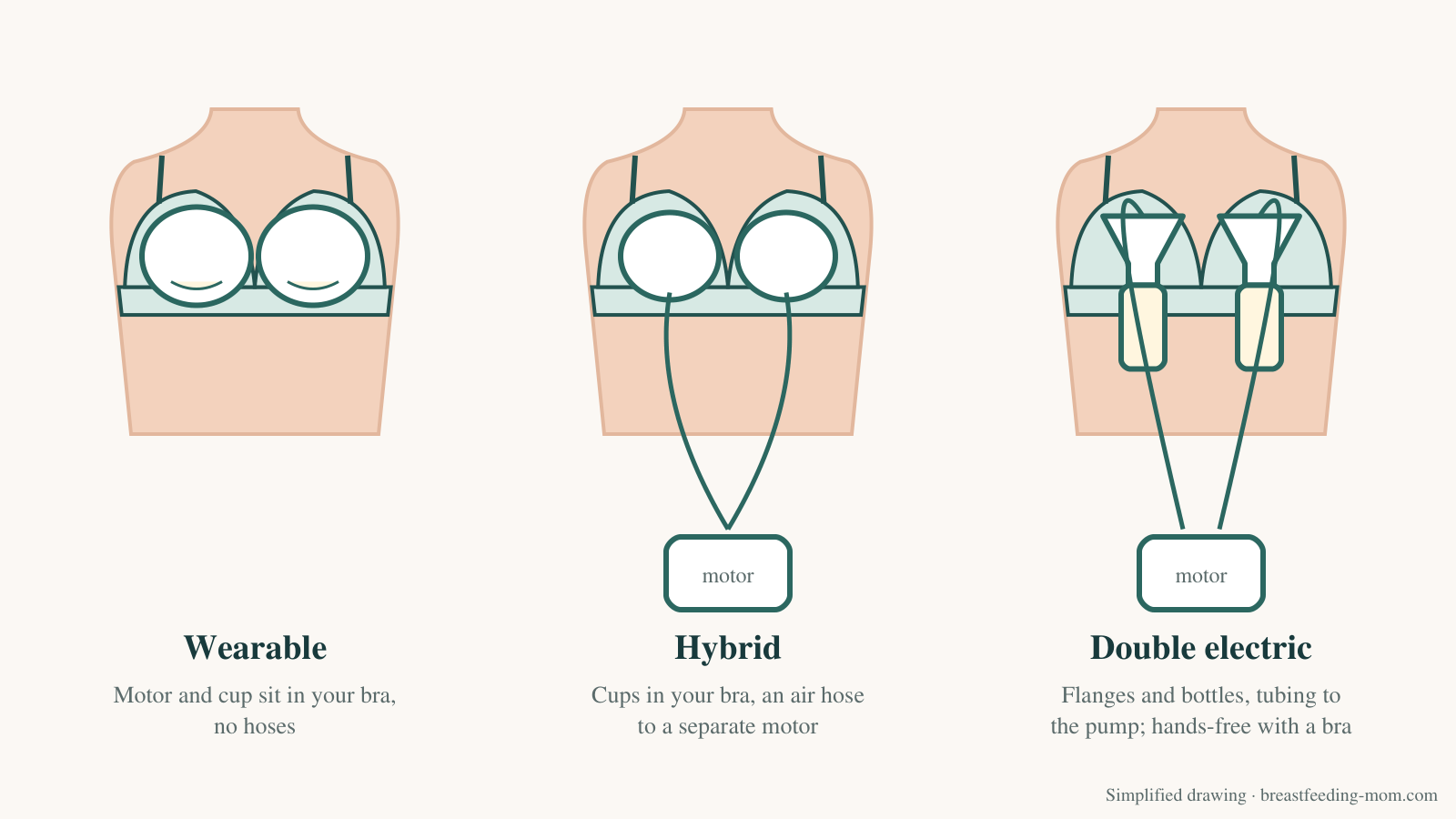
Wearable Breast Pump: How They Work, Pros and Cons, and Fit
An honest guide to wearable breast pumps: how they work, how they compare with traditional pumps, flange fit, cleaning and who they suit best.
Manual Breast Pump: Lever vs Silicone Pumps and How to Use One
How manual breast pumps work, lever vs silicone suction pumps, who they suit, how to use one step by step and how to keep the parts clean.

Pumping Essentials: A Checklist for Home, Work and Exclusive Pumping
A practical pumping essentials checklist: the pump and right flange size, spare parts, storage, cleaning supplies, work gear and what's optional.
Flange Size Calculator: How to Measure Your Breast Pump Flange Size
Measure your nipple in millimeters and get a starting breast pump flange size for each side, plus the signs of a good fit.